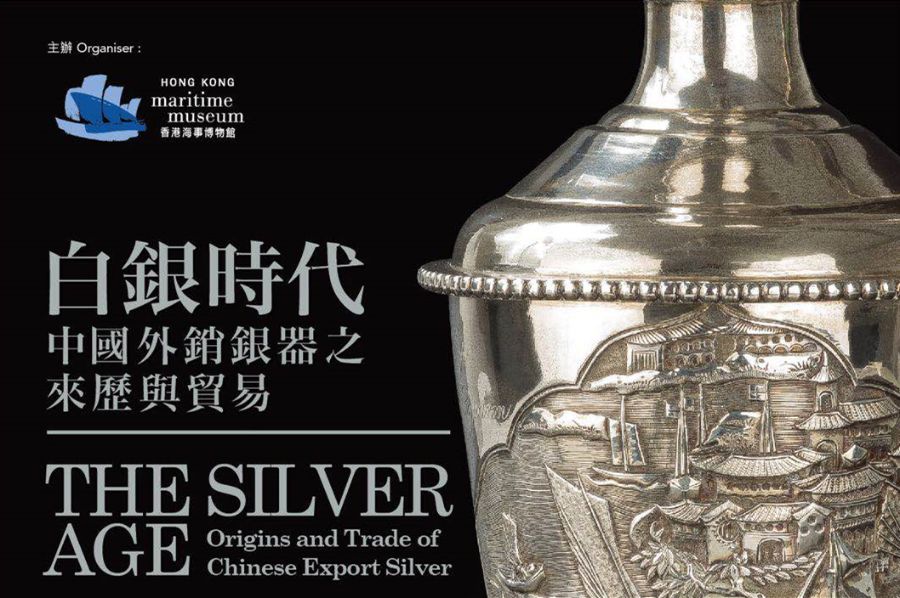
Curated by the Hong Kong Maritime Museum and co-organized by the Home Affairs Department of the Hong Kong SAR Government and the Guangdong Museum, the exhibition The Silver Age: Origins and Trade of Chinese Export Silver was held at the Hong Kong Maritime Museum from December 19, 2017, to February 25, 2018. Presented as a major cultural event celebrating the 20th anniversary of the establishment of the Hong Kong SAR, the exhibition marked the first successful collaboration between the Guangdong Museum and the Hong Kong Maritime Museum.
Silver, one of the earliest forms of currency, is closely tied to global economic development, maritime trade, and international relations, having been widely used since the 15th-century Age of Discovery. The rise of silver craftsmanship spurred artistic and technical exchange between East and West. Beginning with silver’s role in the global economy, the exhibition traces the origins of Chinese export silver and explores Hong Kong’s role as a major export hub for silverware in the 19th and early 20th centuries, as well as its connections with workshops in the Pearl River Delta and beyond. The exhibition is divided into six sections: Global Maritime Trade, Silver Mining and Refining, Origins of Export Silver, Port Workshops, The Guangdong–Hong Kong Connection, and Dining Splendor.
The Guangdong Museum’s collection of Chinese export silver comprises around 150 pieces, mostly dating to the 19th and 20th centuries. The exhibits represent a wide geographical range—from coastal ports such as Guangzhou, Hong Kong, and Shanghai, to inland cities including Jiangxi, Anhui, Tianjin, and Beijing. They include trade goods, souvenirs, and gifts to meet the needs of Western markets, as well as household items or souvenirs for Westerners living in China or Chinese who had embraced Western ideas. In addition, the Museum also holds dozens of "Chinoiserie" silver items produced in European countries like Britain and the Netherlands during the same period, providing rich resources for in-depth comparative research on Chinese and foreign silver.
The exhibition showcases 56 pieces from the Guangdong Museum’s collection, including Guangzhou-made export silverware, Song dynasty silver ingots, and Ming dynasty burial jewelry. These artifacts provide tangible evidence for understanding silver’s role in global economic history and the origins of Chinese export silverware. The categories of export silverware include household ornaments, jewelry, clocks and watches, wine sets, and tea sets, which are diverse in form and exquisite in craftsmanship. For objects sharing similar artistic styles, shapes, or decorative motifs, European silverware has been specially selected for comparison, enriching the exhibition from multiple dimensions and perspectives.
1. “SW” Sheffield-Made Silver Tea Set with Floral Chased Decoration in Art Deco Style
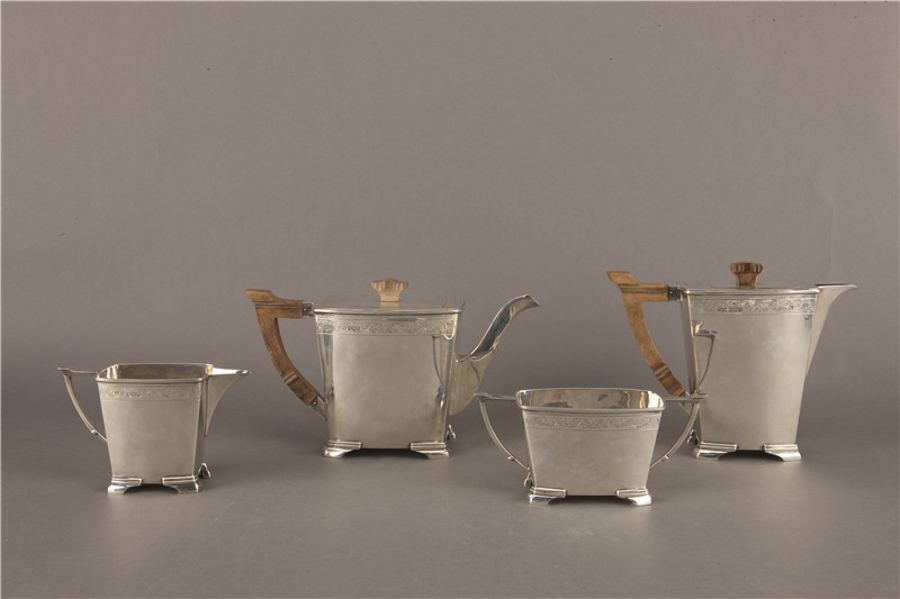
1939
Teapot: L 25.5 × W 9.8 × H 15 cm
Coffee pot: L 21 × W 8.5 × H 17 cm
Sugar bowl: L 17.4 × W 7 × H 8 cm
Cream jug: L 14.6 × W 6.5 × H 9 cm
Weights: teapot 770 g; coffee pot 665 g; sugar bowl 270 g; cream jug 245 g
2. “WH” Silver Plain Tea Set in Imitation Art Deco Style
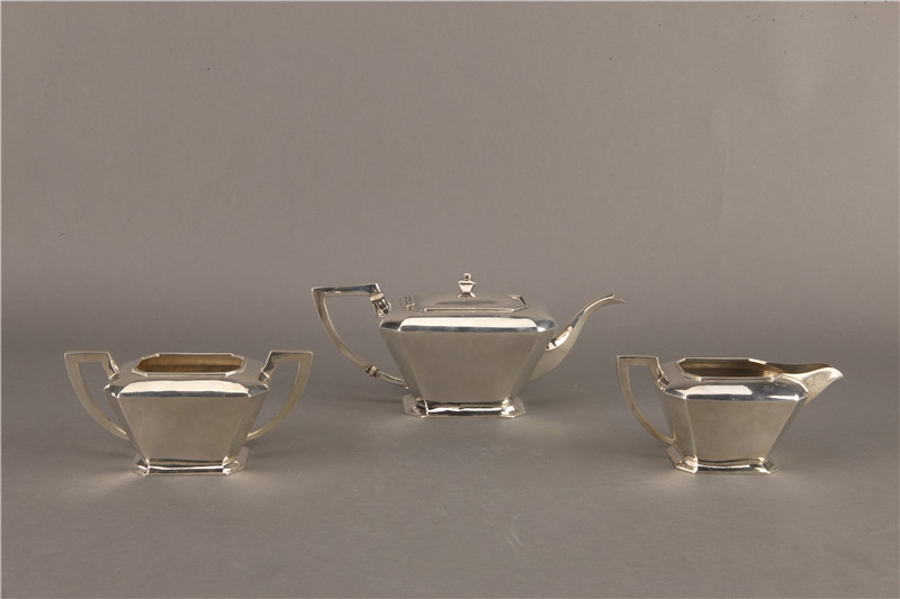
1930
Teapot: L 25.5 × W 10.3 × H 11.5 cm
Sugar bowl: L 16.1 × W 8 × H 8 cm
Cream jug: L 16 × W 8.2 × H 7.8 cm
Weights: teapot 505 g; sugar bowl 215 g; cream jug 180 g
3. Sheffield-Made “Chinoiserie” Silver-Plated Tea Set with Chased Pavilion-and-Figure Motifs
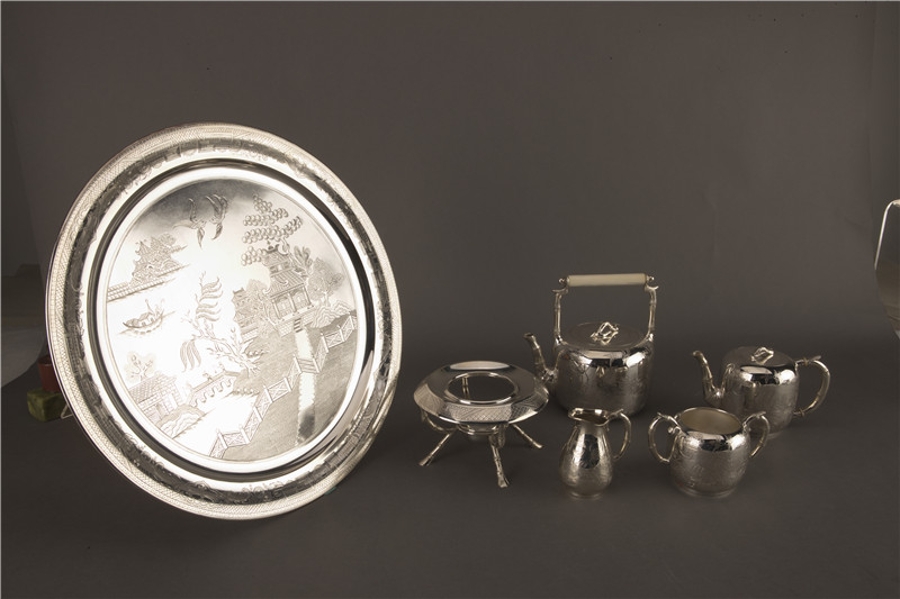
1880-1890
(1) Kettle L 16.9 × H 17.8 cm
(2) Stand Dia. 14.8 × H 8.9 cm
(3) Burner Dia. 5.4 × H 4.5 cm
(4) Teapot L 15.8 × H 10.5 cm
(5) Sugar bowl L 12.5 × H 8.5 cm
(6) Cream jug base Dia. 4.2 × H 9 cm
(7) Tray Dia. 38.5 × H 2.7 cm
Weights: (1) 690 g; (2) 290 g; (3) 65 g; (4) 330 g; (5) 190 g; (6) 110 g; (7) 1300 g
4. “Jiujiang Tumaoxing” Silver Square Tea Set with Chased Bamboo Design
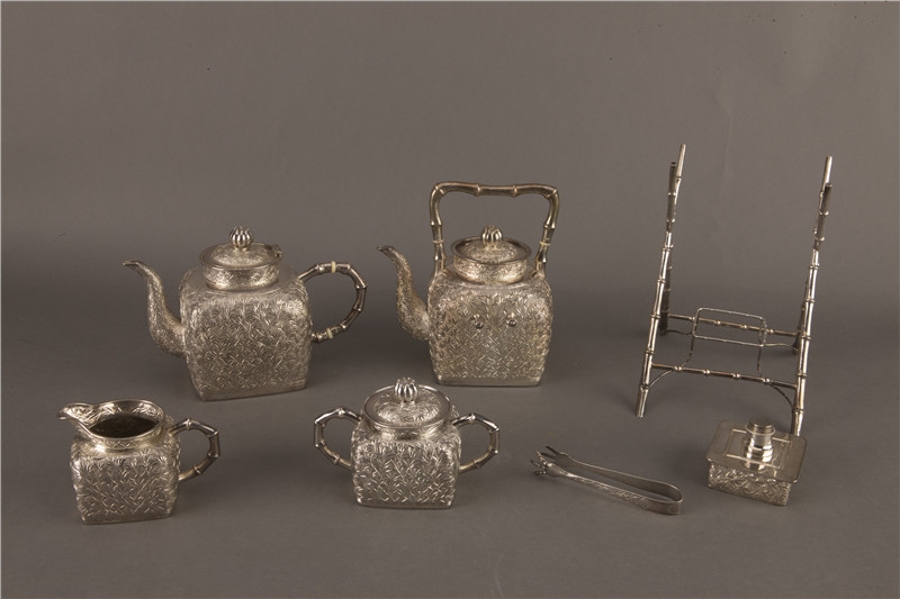
1900-1910
Kettle: L 16.5 × H 19 cm
Stand: L 20.9 × W 14.6 × H 22.7 cm
Burner: L 7.2 × W 7.4 × H 5.5 cm
Teapot: L 22.5 × H 14.6 cm
Sugar bowl: L 14.3 × H 9.1 cm
Cream jug: L 11 × H 7.8 cm
Tea Tongs: L 12.5 × W 1.8 cm
Weights: kettle 590 g; stand 410 g; burner 115 g; teapot 570 g; sugar bowl 245 g; cream jug 135 g; tea tongs 35 g
5. “KHC” Silver Tea Set with Floral Chased Decoration in Neo-Renaissance Style
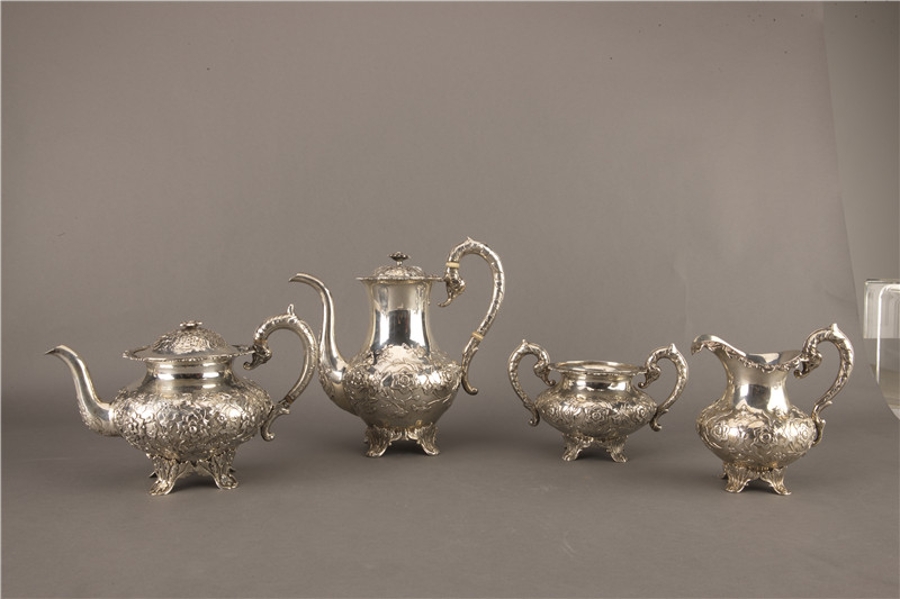
c. 1840
Teapot: L 26.5 × H 18 cm
Coffee pot: L 26.3 × H 26.8 cm
Sugar bowl: L 21 × H 13.7 cm
Cream jug: L 15.7 × H 17 cm
Weight: 1025 g
6. J.C. Edington “Chinoiserie” Silver Tea Set with Pavilion-and-Figure Chased Medallions
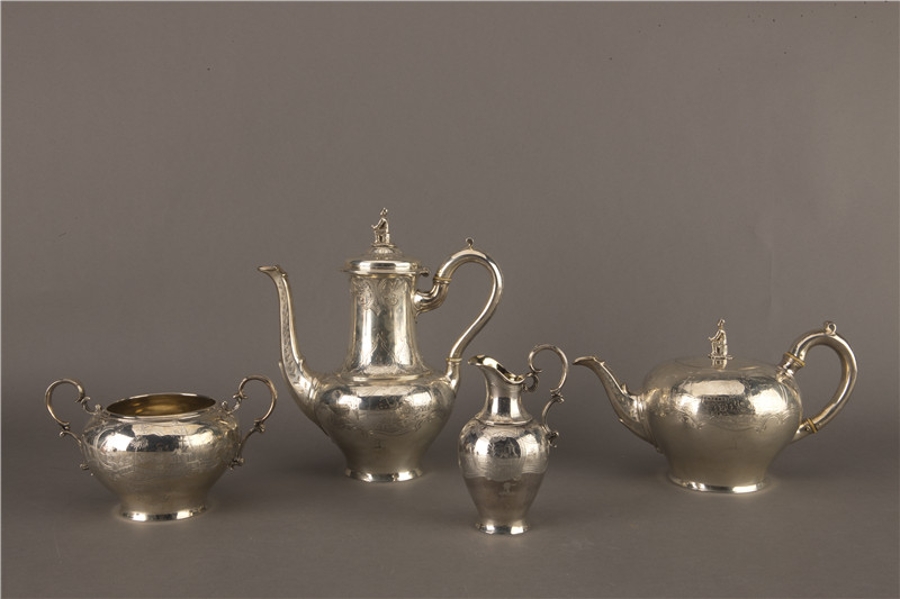
1840
Teapot: L 25.9 × H 15.5 cm
Coffee pot: L 23.4 × H 21.5 cm
Sugar bowl: L 19 × H 12 cm
Cream jug: L 7.5 × H 15 cm
Weights: teapot 680 g; coffee pot 875 g; sugar bowl 380 g; cream jug 230 g